


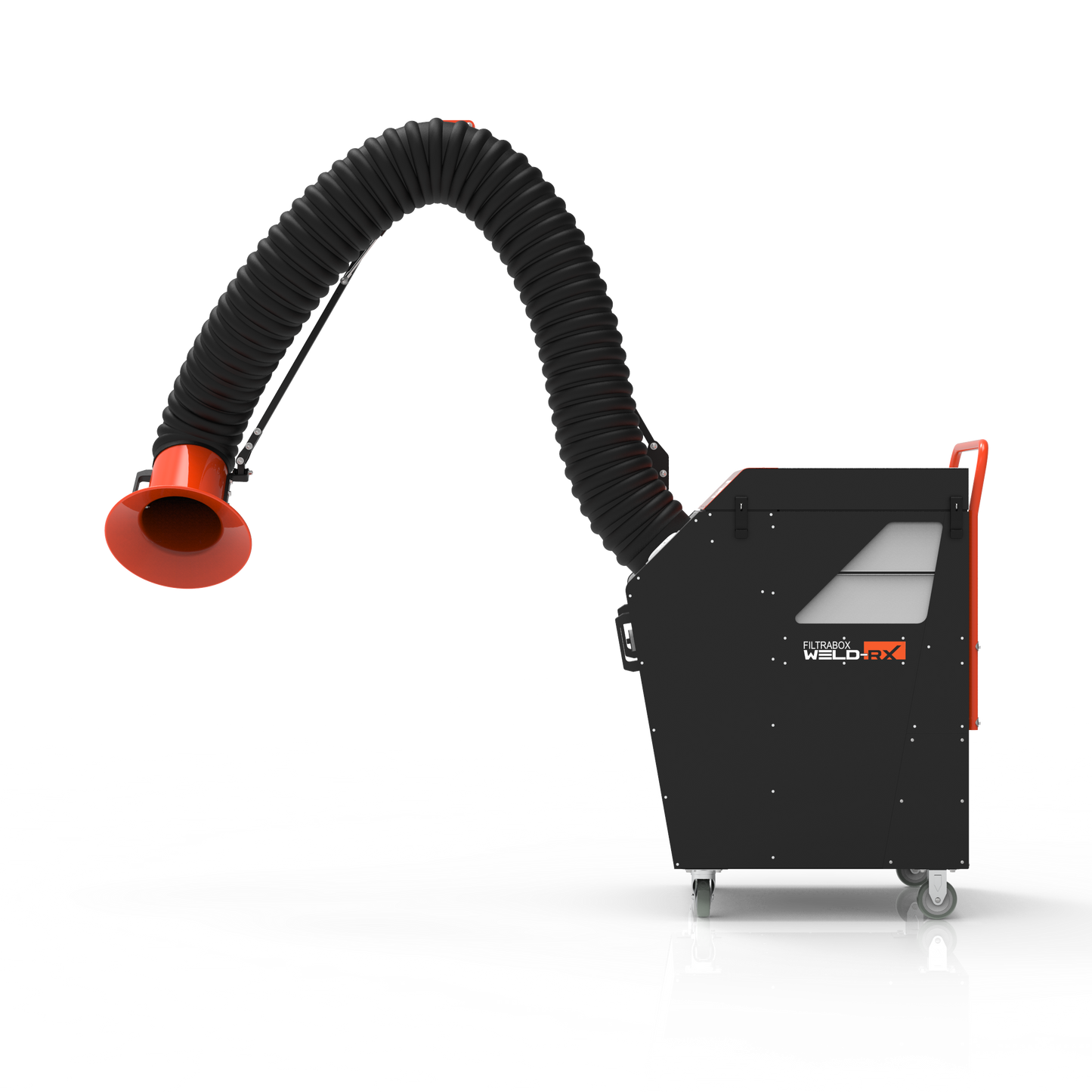
How Weld-RX filters fume
Air passes through each stage in order.
1
Spark Arrestor
Catches sparks and hot particles before they reach the filter media. Washable and reusable.
2
Pre-Filter (F9 (MERV 16 equivalent))
Takes the coarse and fine particulate so the HEPA only handles what gets past it. Cheaper to replace, which is the point. F9 equals MERV 16.
3
HEPA (H14)
Captures the ultrafine submicron particulate that reaches deep into the lungs.
High-Velocity Fume Capture in Action
Effective source capture removes hazardous welding fumes before they spread through the workspace. Designed to help maintain air quality standards while improving overall shop safety and comfort.
Applications
-

Laser Welding

Traditional Handheld Welding

Soldering

Rust and Paint Removal
-
Laser Welding
Traditional Handheld Welding
Soldering
Rust and Paint Removal
-
Laser Welding
Traditional Handheld Welding
Soldering
Rust and Paint Removal
-
Laser Welding
Traditional Handheld Welding
Soldering
Rust and Paint Removal
-
Laser Welding
Traditional Handheld Welding
Soldering
Rust and Paint Removal
-
Laser Welding
Traditional Handheld Welding
Soldering
Rust and Paint Removal
-
Laser Welding
Traditional Handheld Welding
Soldering
Rust and Paint Removal
-
Laser Welding
Traditional Handheld Welding
Soldering
Rust and Paint Removal


Questions about Weld-RX
What does a welding fume extractor actually do?
Welding and laser welding generate ultrafine particulate that stays airborne and is small enough to be inhaled deep into the lungs. A fume extractor captures that particulate at the source, filters it, and returns clean air to the shop. Source capture is the key part. Pulling fume at the arc is far more effective than trying to filter a whole room after it has already dispersed.
How is Weld-RX different from the Weld-R?
Weld-RX is the newer version of the Weld-R laser welding fume extractor, not a separate product line. The main upgrades are filter area and airflow. Weld-RX carries 22 m2 of filter media where Weld-R carried 15 m2, and it moves 1200 CFM through a steel mesh spark arrestor, F9 pre-filter, and H14 HEPA. More media means longer filter life at the same duty cycle. It is built for laser welding but also handles handheld welding and soldering.
Can I use this indoors without outside exhaust?
Yes. Every Filtrabox unit is designed for indoor use with no outdoor ventilation required. Air is captured at the source, filtered, and recirculated back into the workspace, which means no ducting through a wall or roof and no conditioned air being pumped outside. One thing to confirm for your process: recirculation depends on the filtration matching what you produce. Particulate is handled by the standard configuration, and gases or VOCs require the carbon cartridge.
Does it remove gases and VOCs, or only particles?
Pre-filters and HEPA filters capture particles. They do not remove gas-phase contaminants. If your process produces gases, odors, or VOCs, you need the activated carbon chemical cartridge, which adsorbs them. Most welding and laser welding is a particulate problem, so the standard configuration is usually the right one. Processes involving coatings, plastics, or chemicals are where carbon matters.
What is the difference between a pre-filter and a HEPA filter?
They do different jobs and they are not interchangeable. The pre-filter takes the coarse and fine particulate first, so the HEPA only has to deal with what gets past it. The HEPA then captures the ultrafine submicron material at 99.999% efficiency on 0.3 micron particles. Because the pre-filter absorbs most of the loading, it is the element you replace more often, and it is the cheaper of the two. That is by design.
Can the filters be cleaned instead of replaced?
The steel mesh spark arrestor is washable and reusable, so that one gets cleaned rather than replaced. The pre-filter and HEPA cannot be cleaned. Attempting to blow out or wash filter media damages the fibers and destroys the efficiency rating, which defeats the purpose of having a HEPA in the first place. Those are replacement items.
How often do the filters need to be replaced?
There is no fixed interval, because filter life depends on what you weld, how much, and at what duty cycle. A shop running production all day loads filters far faster than one welding a few hours a week, and heavier particulate processes load them faster still. Rather than guess at a calendar, watch the pressure gauge. Rising pressure across the filter means it is loading up and approaching replacement. The pre-filter is designed to be the element you change most often, which protects the more expensive HEPA behind it.
Which Filtrabox welding extractor should I choose?
All three move 1154 to 1200 CFM, so airflow will not decide it. How and where you work will. Nomad is the one that leaves the building, at 154 lbs with a 30 inch doorway clearance for field service and mobile crews. Weld-RX is the shop workhorse, on casters so it repositions around the floor, with the largest filter area in the line at 22 m2 for high duty cycle work. Vert-X mounts on the wall and gives up mobility entirely in exchange for zero floor space. Contact the factory if you are unsure, since duty cycle and application matter more than the headline airflow number.
Who is Weld-RX designed for?
Weld-RX is built for shops running laser welding as a production process. It rolls on casters, so it repositions around a cell or moves between bays as the work moves, without giving up the capacity of a full shop unit. It moves 1200 CFM through 22 m² of filter media, the largest in the Filtrabox welding line, which means longer filter life at high duty cycle. A steel mesh spark arrestor and F9 pre-filter protect the HEPA, so the expensive element is not doing work the cheap one should. Choose it when the extractor runs most of the day and you want mobility on the shop floor rather than off-site portability.
Ideal for
- Production laser welding
- Handheld welding and soldering
- High duty cycle operation
- Rolling between bays and workstations
- Shops prioritising filter life and capacity