


Applications
-

Laser Cleaning

Rust and Paint Removal
-
Laser Cleaning
Rust and Paint Removal
-
Laser Cleaning
Rust and Paint Removal
-
Laser Cleaning
Rust and Paint Removal
-
Laser Cleaning
Rust and Paint Removal
-
Laser Cleaning
Rust and Paint Removal
-
Laser Cleaning
Rust and Paint Removal
-
Laser Cleaning
Rust and Paint Removal


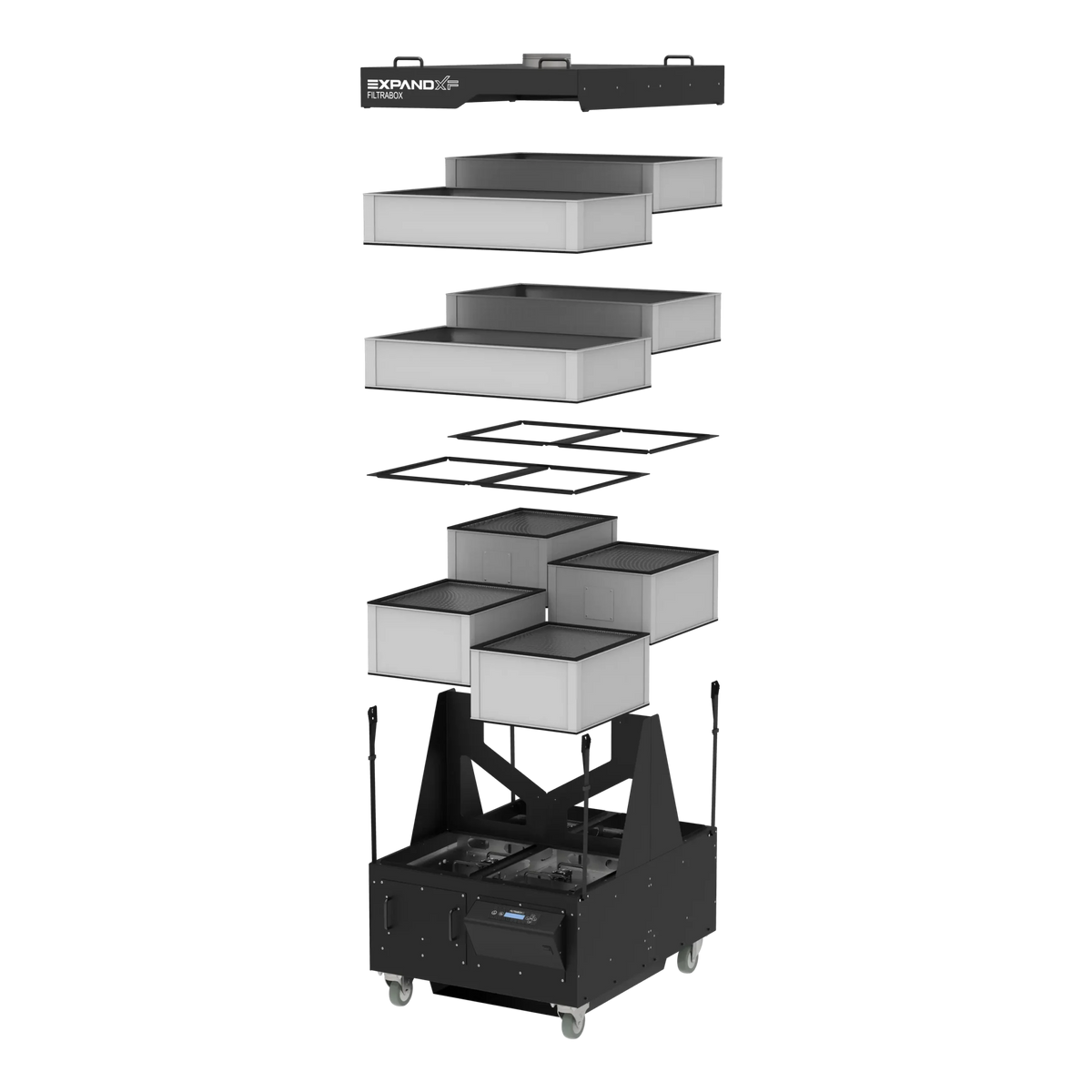
How Expand XF-3 filters fume
Air passes through each stage in order.
1
Pre-Filter
Takes the coarse and fine particulate first so the HEPA only handles what gets past it. Cheaper to replace, which is the point.
2
HEPA (H14)
Captures the ultrafine submicron particulate that reaches deep into the lungs.
3
Chemical Cartridge
Handles gases rather than particles. Carbon and potassium permanganate adsorb VOCs and odors that particle filters cannot.
Who is Expand XF-3 designed for?
Expand XF-3 is the three-blower configuration at 705 CFM, built for continuous operation or for supporting multiple laser cleaning systems at once. It is the answer when one extractor has to keep up with more than one head, or when the work runs all shift. Like the rest of the XF platform it is expandable, up to six blowers, so capacity can grow again without replacing the unit.
Ideal for
- Continuous laser cleaning operation
- Multiple laser cleaning systems
- Heavy-duty industrial applications
- Maximum airflow requirements
Rust removal can produce a variety of very harmful gasses. It is imperative to protect not only the operator, but also the entire area.

Questions about Expand XF-3
What is a laser cleaning fume extractor?
A laser cleaning fume extractor captures and filters the airborne contaminants produced when a laser strips rust, paint, oxide, oil, or coatings from a surface. Laser cleaning does not scrape material off, it vaporizes it, so the byproduct goes airborne immediately. The extractor pulls it at the source, filters both the particulate and the gases, and returns clean air to the shop rather than venting outdoors.
What is the difference between Expand XF-1, XF-2, and XF-3?
Blower count, and therefore airflow. XF-1 runs one blower at 235 CFM, XF-2 runs two at 470 CFM, XF-3 runs three at 705 CFM. The XF platform is expandable up to six blowers. Pick the configuration that matches your duty cycle and how many laser cleaning heads the unit needs to support.
What is actually in laser cleaning fume?
Two different problems in one plume. There is fine and ultrafine particulate from the substrate and from the material being removed, and there are gases and VOCs from whatever coating just got vaporized. Paint, primer, oil, and rust inhibitors all release gas-phase contaminants when a laser hits them. That mix is why laser cleaning extraction needs both particle filtration and carbon, not just a HEPA.
Why do laser cleaning extractors need carbon filtration?
Because pre-filters and HEPA filters only capture particles. They do nothing to gases. Laser cleaning vaporizes coatings, and vaporized coatings are gas-phase contaminants, so a particle-only setup would return odors and VOCs straight back into the room. Every Filtrabox laser cleaning unit ships with coconut shell carbon and potassium permanganate cartridges as standard for that reason, ranging from 40 lbs on the Compact X-LC up to 240 lbs on the Expand XF.
How much airflow do I need for laser cleaning?
Airflow needs to match how fast you are removing material and how far the extraction point sits from the work. A single handheld laser cleaning head is usually well served by 235 CFM. Higher-power systems, larger standoff distances, running two heads at once, or continuous production all push the requirement up, which is what the multi-blower configurations are for. Contact the factory with your laser wattage and duty cycle rather than sizing on airflow alone.
Can I use this indoors without outside exhaust?
Yes. Every Filtrabox unit is designed for indoor use with no outdoor ventilation required. Air is captured at the source, filtered, and recirculated back into the workspace, which means no ducting through a wall or roof and no conditioned air being pumped outside. One thing to confirm for your process: recirculation depends on the filtration matching what you produce. Particulate is handled by the standard configuration, and gases or VOCs require the carbon cartridge.
What is the difference between a pre-filter and a HEPA filter?
They do different jobs and they are not interchangeable. The pre-filter takes the coarse and fine particulate first, so the HEPA only has to deal with what gets past it. The HEPA then captures the ultrafine submicron material at 99.999% efficiency on 0.3 micron particles. Because the pre-filter absorbs most of the loading, it is the element you replace more often, and it is the cheaper of the two. That is by design.
Can the filters be cleaned instead of replaced?
No. The pre-filter, HEPA, and carbon cartridge are all replacement items. Blowing out or washing filter media damages the fibers and destroys the efficiency rating, which defeats the point of having a HEPA at all. Carbon works by adsorption and is spent once it is saturated, so cleaning does nothing for it either. The pre-filter is designed to load first and be replaced most often, which is what protects the more expensive elements behind it.
How often do the filters need to be replaced?
There is no fixed interval, because filter life depends on what you weld, how much, and at what duty cycle. A shop running production all day loads filters far faster than one welding a few hours a week, and heavier particulate processes load them faster still. Rather than guess at a calendar, watch the pressure gauge. Rising pressure across the filter means it is loading up and approaching replacement. The pre-filter is designed to be the element you change most often, which protects the more expensive HEPA behind it.
Which Filtrabox laser cleaning extractor should I choose?
Start with duty cycle, then filter capacity. Compact X-LC is the smallest footprint at 235 CFM with 40 lbs of carbon, for light to intermediate work. Expand X-1LC matches that airflow with far more media, 30 m2 of pre-filter and 79 lbs of carbon, and can take a second blower later to become the X-2. Expand XF is the heavy-duty platform, 44 m2 filters and H14 HEPA with 240 lbs of carbon, expandable from one to six blowers. XF-1 at 235 CFM, XF-2 at 470, XF-3 at 705.